
Freediving is fun, right? There’s a potential loophole you can exploit to do more of what you love in a fun and relaxed way, without covering all the costs. With the growth of freediving as a sport, more local and national competitions are happening. There is a need for trained, experienced, and available safety freedivers to be present at these competitions.
What is a competition safety freediver (role desctiption)
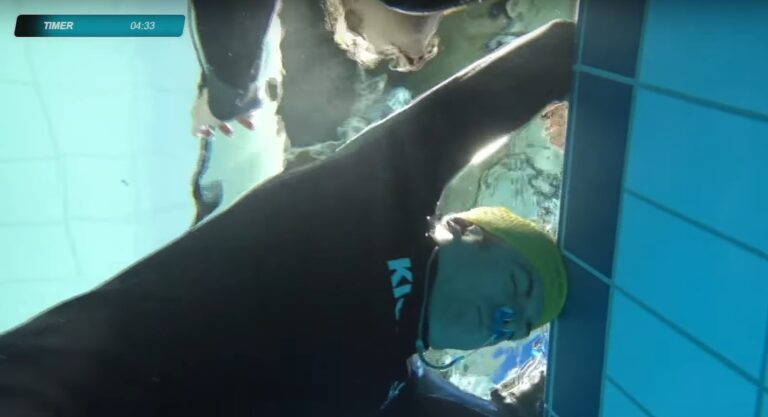
The standard competition setup consists of three safety freedivers on the main line, plus one or two on the warm-up lines who can also take over one of the main line roles should complications occur. Here’s an example of how a team works during a competition for the main line – video example1:
– First safety meets the athlete at about 1/3 of their target depth, first meeting point.
– Second safety meets the athlete and first safety 10-15 meters above the first meeting point.
– Third safety awaits at the surface, always ready to descend.
Available course options
When looking for a “competition safety freediver course,” several options emerged.
One option (A2) published a detailed curriculum, a second one (B3) also has a curriculum available online with broader bullet points, and for a third option (C4) you are invited to send an e-mail and ask for what interests you.
If we read across all options, including the third one, and sum up, we get the following similar points:
– There are prerequisite physical skills which you will be tested on during the course.
– There is theory
– There are rescue drills you must perform alone and/or as a team
– There is a test at the end 😊
Physical skills – prerequisite to the course
Unlike the usual level-up courses, signing up for a competition safety course should also put you in a bit of a training mode. As a safety diver, you will need to be reliable and consistent with your dives. This brings self-confidence and projects that confidence towards the athletes, turning the competition into a safer space for them to perform at their best.
A break point for competitions is around 80 meters, splitting them into max depth 80 meters and max depth more than 80 meters. Competitions with depth world record attempts (ranging from 100 to 140 meters) will require the use of a “safety 0” who will meet the athlete at around 45 meters. Additionally, these competitions will prefer having safety freedivers who have been through a few competitions with similar conditions (water temperature, visibility, current).
Reading across the available courses, the prerequisites for competitions with a max depth of around 80 meters are on average:
– 30-35m CWTB with a mask and snorkel attached to it.
– Being able to dive and wait for the athlete. Dive with a hang at around 20m
– Consecutive dives with short surface recovery time or short notice.
– Preferably, athlete experience.
Gear
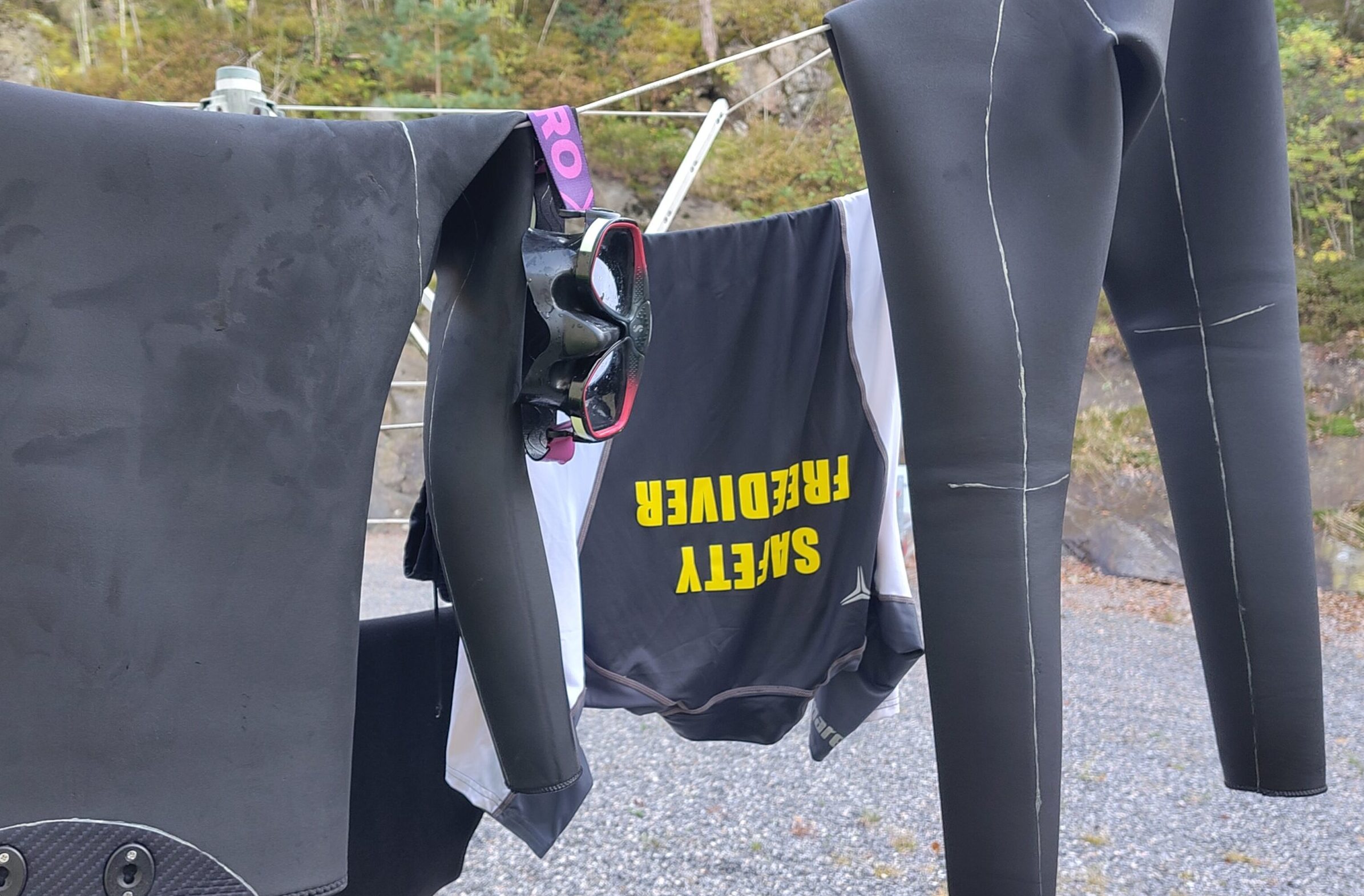
As a safety freediver, you need to be comfortable and warm in your wetsuit. Consider the fact that you’ll have to spend 3-6 hours in the water, and if you are part of a rotating team, you won’t dive that much – about once every 10-15 minutes. Conditions always change both at the surface and underwater, so it is important to stay warm. Consider a slightly thicker wetsuit or adding a vest under your wetsuit. During breaks, you can pour lukewarm water into your wetsuit to warm up, or cold water to cool off. 😊
You’ll need a pair of bi-fins. It is allowed to use any kind, but the kind that saves you the most energy would be ideal. Also, consider that you will potentially swim up your weight and the athlete’s. It is worth working towards having a good duckdive, efficient finning technique and leg strength.
A mask is a must as you’ll have to see well. If you wear glasses, it is possible to find masks with special lenses or extra lenses that you just glue on the mask. It is safe to wear contact lenses with a mask. Some freedivers even wear them when they don’t use a mask.
One way of being quicker on the way up is having your neutral buoyancy depth a bit deeper than usual. Normally, one sets the neutral buoyancy at about 10-12 meters, but when you train to become a safety diver and in competition scenarios, it is best to aim for a neutral buoyancy point at 15-17 meters. Should you have to bring an athlete to the surface as quickly as possible, this will help.
The snorkel becomes important when you are at the surface checking down for divers or what is going on with safety 1 and safety 2.
What needs to be trained based on the course prerequisites and expected rescue drills
Depth and equalisation: Be comfortable and consistent at 30-35m. This will need to be done with bi-fins and a mask. You should already have all the necessary tools and knowledge from previous freediving courses for equalisation.
Equalisation with high CO2 levels: If you can equalise, you haven’t tried equalising with high CO2 levels. This means consecutive dives or short surface recovery times.
Rescue scenarios: Recall and rehears rescue techniques from the freediving courses you’ve taken so far.
Strength: You’ll use your legs quite a bit both finning yourself up and down and sometimes finning the athlete up, too.
Duck dive and finning technique: As mentioned before, preferably practice with less belt weight.
Effort under pressure: Handle your body weight and another diver’s at 20-25 meters underwater, moving both of you up towards the surface.
Training suggestions/examples specific for a safety freediver
For equalisation in the pool, practice going down from the surface with anything in between a mouth full of air and no air at all in the mouth. For open water equalisation practice you can try a similar exercise as the pool one. Since as a safety diver you won’t go too deep you can also experiment with leaving the surface with less air in your lungs, only get a max inhale through a snorkel, or even FRC dives to simulate the pressure of greater depths.
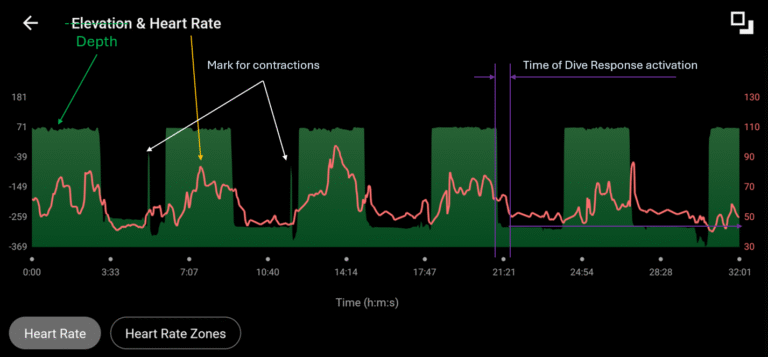
For equalising with high CO2: Having a high CO2 level, from a previous dive for example, makes relaxing and equalising a bit more challenging. You will for sure experience a high heart rate as a consequence of the previous dive. A good exercise to experience this is depth fixed intervals with bi-fins.

For leg strength and lactic: Apnea squats5 seem to simulate quite well a rescue from depth. There are different variations of this exercise, but to start, you can try with 30 seconds static followed by 30 seconds of squatting. You can play with the number of repetitions and the time dedicated to each phase to suit your level. For more general freediving strength exercises, you can also refer to this video6.
For developing breath hold under stress: walking while an empty lungs breath hold7 also known as, RV walks, is a useful exercise for getting comfortable with finning at greater depths but still a fun and challenging way to train. During RV walks, you’ll experience what it feels like to move your legs while your lungs are at residual volume. It’s actually easier to observe how relaxed your abdomen is during this exercise on land, compared to in the water, where you’re also coordinating other movements. Take it slow, listen to your body, and focus on how it reacts to the exercise.
Technique and duck dive: This exercise can be done at the deep end of a pool. Start with 2 minutes of vertical surface kicking (variation: with elbows above the water) followed by a duck dive and a DYNB dive. You can choose the length of the dive based on your training level and gradually increase it as you progress. Adding a DYNB dive after the kicking simulates diving without a proper breathe-up, which can happen for a safety diver in a competition scenario.
Practice rescues from 10m, 15m, and 20m with the help of your training buddy. You’ll be doing this a lot during the course, so it’s helpful to get familiar with swimming towards the surface caring a diver.
Growing as competition safety freediver
A first step into this world is to train consistently and become confident in meeting the minimum requirements. That way, when you attend the course, your energy can go into learning how to work as part of a team and understanding the responsibilities of each role. Feeling physically prepared—especially for performing rescues—will allow you to focus more on the bigger picture: how the safety team functions as a unit, how to support athletes effectively, and how to stay calm and efficient under pressure.
The path to becoming a skilled competition safety freediver is both rewarding and full of learning opportunities. Courses are typically structured in levels, with each one building on your experience and comfort in the water. While it’s possible to pass an advanced-level course if you’re already a strong diver, that doesn’t automatically mean you’ll be ready to join high-level competitions right away.
Beyond the physical prerequisites and rescue drills, these courses focus heavily on teamwork, communication, role awareness, and reaction times. These are the skills that truly define a great safety diver.
With time and practice, you’ll not only grow as a diver but also become a valuable part of any competition safety team.
Final thoughts
The safety freediver course usually lasts around three days, while depth competitions can range from two to nine days. During these events, you might spend 4 to 6 hours in the water each day, performing multiple dives. It’s physically demanding, so it’s essential to take care of your body: stay well-hydrated, eat nourishing food, and get plenty of rest.
Being part of a safety team is more than just a role—it’s a chance to grow, connect with the freediving community, and learn from real-life scenarios. The journey might seem intense at first, but with a bit of regular training and the exercises shared in this article, passing the course is absolutely within reach.
Whether you’re aiming to support competitions or simply want to deepen your understanding of freediving safety, this path offers a meaningful and exciting way to be part of the sport.
Never dive alone, always bring a buddy and talk through your dive plan together before getting in the water!